no non piango. mi è solo entrato un moscerino nell'occhio.

é tutto il giorno che il mio cellulare non si comporta come dovrebbe. io lo guardo,fulminandolo. anche un pirla capirebbe. eppure il nome che vorrei leggere non compare. e allora forse è che ha dei problemi la mia compagnia telefonica...sì sì può darsi! passo a wind. domani passo...e basta sentimentalismi anche per queste stronzate. eh...però...vodafone è tutta intorno a me,mi avvolge con il suo rosso pathos,non mi lascia scampo...che posso fare? l'arancione melone di wind mi disgusta...

eppoi chi prendo in giro? lui non chiamerà. ed è proprio questo che mi fa impazzire.


Man%20Ray%20-%20Les%20Larmes%20(Tears)%20-%20T1


lui deciderà di ritirarsi nel suo guscio,al sicuro. eviterà così ogni rischio,si sentirà tranquillo. dormirà,mangerà,penserà, evitando sempre qualsiasi contatto col circostante, stando bene attento a non uscire troppo dal riparo. e finirà col pensare di essere l'unica persona su questa terra, l'unica forma di vita, perchè degli altri possiede solo una vaga immagine, immagine che si muove ma non per questo ha esistenza effettiva. solipsismo per lui. esilio volontario. addio...


lei rimarrà a guardarsi attorno,mentre il cielo gocciola,si sentirà smarrita,però solo per poco. poi correrà via veloce, rischiando di scivolare nelle sabbie mobili. si salverà. troverà calore da un'altra parte, come ha sempre fatto. cancellerà il ricordo di lui, vivrà bene comunque. sorriderà. ballerà. farà l'amore. un giorno si innamorerà pure. forse. perhaps perhaps perhaps...


riva del garda

I miei ritorni a Riva mi sconvolgono sempre un po'.

Mi sorprende sempre notare quanto i "fili invisibili" siano ancora efficaci.
La mia volontà s'intimorisce di fronte ad una forza ben più antica, profonda, distruttiva.
No, non perdo più il controllo, questo no. Ho imparato a mie spese a soffocare ogni impulso che non ha ragione d'essere...
però lo sento...
mi sospinge come una corrente...
mi si creano immagini negli occhi...
la mia personalità rivela il suo doppio,
qui a Riva.
Quel doppio che tutte le volte a Bologna penso di aver ucciso con la coerenza delle mie azioni e l'equilibrio delle mie emozioni.
E invece vaffanculo no!
Sento le voci talvolta:
-chiamalo e chiedigli di scappare insieme a te, via, lontano da qui, per tendere verso tramonti dorati, tu e lui, soli, finalmente felici. chiamalo, chiamalo è così semplice...-

Per un attimo mi sento conquistata da questa menzogna,
poi ritorno in me, accorgendomi della follia di tutto ciò.
Sono pazza, lui aveva ragione a dirmelo. Ne sto uscendo, e il peggio è passato sì, ma ho ancora delle ricadute. Quando torno a Riva.

Combatto ancora contro fantasmi che dal passato vengono a disturbare il mio sonno.
Ho ancora da capire e risolvere, forse non ci riuscirò mai perchè alcune domande non hanno risposte, o meglio le hanno ma io non potrò mai afferrarle in pieno.
Ho solo ipotesi che si sommano fino a creare una teoria che prendo per vera, la prendo e la utilizzo come fondamento... e se...? Sì, proprio così, crollerebbe tutto.

METAMORFOSI

Tanto tempo fa io non ero io. Ero non-so-chi, ma sicuramente non ero io. O meglio, per quanto riguarda la mia intima essenza, beh quella è rimasta inalterata...la mia coscienza, la mia anima,il mio ideale trascendentale, chiamatelo come volete, quella cosa che senti dentro e ti fa capire di essere un individuo distinto e unico, quella cosa era come è ora.


Ma ecco,c'era tutto intorno a questa mia anima come uno strato di sporco verdastro...una sorta di muffa, un livello basso,infimo,riprovevole di vita. Quasi un parassita. Questo essere a me estraneo si era a tal punto e per così tanto tempo insediato dentro il mio corpo che lo riconoscevo come mio. Mi sembrava nella normalità e allo specchio stentavo a riconoscermi, ma mi convincevo che ciò fosse normale.


Poi un giorno successe che il mondo mi chiuse fuori, mi ecluse. O forse io mi nascosi dal mondo? Era buio anche quando splendeva il sole d'estate, non c'era la benchè minima presenza di colore, sapore o odore. Ero rinchiusa e c'ero solo io. In quel periodo, che ricordo ancora con ansia e ripugnanza, presi coscienza dolorosa di ciò che si era impadronito di me. Dapprima mi fece ancora di più limitare ogni contatto con il circostante, poi decisi che era giunto il momento di affrontare quel morbo che dalla nascita mi aveva eclissato l'anima.


Chiusa lì dentro, nel mio piccolo inferno di seta, le mie lacrime si fondevano ai miei silenzi. Sentivo solo un leggero tremore nel mio corpo, ogni giorno un poco più forte, come se ogni attimo mi avvicinasse sempre più ad un avvenimento che mi avrebbe permesso di rivedere la luce.


Ero chiusa nel mio dolore, in quarantena, da giorni, mesi, anni. Il tempo era impossibile da misurare...


Un attimo il mio cuore sembrò smettere di pompare sangue nel mio corpo immobile. Pensai che quella fosse la morte. Lo pensai e accettai questo pensiero, accettai l'eternità che mi vedeva prigioniera in me stessa. Lo accettai. Una grande calma si diffuse in tutte le mie membra, mi sentii come scogliere in un liquido caldo e vischioso.


Provai un brivido bollente dall'inguine e su su fino ai capelli e giù giù fino alle punte dei piedi. Emanai luce gialla dal petto, la mia pelle era trasparente, lasciava intravedere le vene gli organi i muscoli perfettamente funzionanti e tutti tesi verso quel grande piacere che era lì lì per giungere.


Non c'era luce fuori, proveniva da me. Non c'era sole, ero io la fonte di calore. Mi sentivo viva e quando mi mossi per abbracciare il mondo esterno che mi era stato negato per così tanto, notai che mi libravo nell'aria.


Non avevo più o stesso corpo, le mie zampe erano ali robuste e dipinte d'arcobaleno. Il mio corpo era leggero e sinuoso, i mei occhi percepivano ogni dettaglio più nascosto. Il mio olfatto era altamente sviluppato, sentivo odori di fiori di diverse specie, vedevo colori che quasi facevano male.


Le farfalle vivono molto poco, solo pochi giorni.


Ma quel poco che vivono è di un'intensità che non possiamo comprendere, come un orgasmo continuo che coinvolge ogni organo sensoriare.


Poi si spengono, stanche, sull'unico fiore che sa trattenerle a sè.


Il fiore più bello, profumato, il più esotico e intenso.


Il fiore che le mangia vive senza pietà e che si nutre della loro luce.


Il fiore carnivoro.


PAZZIA,SI SUOL DIRE


madness

io penso. dunque sono. dunque? ...


ma a che penso? aaaaaaaaaaaaaaaa


aaaaaaaaaaaaaaaaaaaaaa


aaaaaaaaaaaaaaaaaaaaaaaaaa


aaaaaaaaaaaaaaaaaaaaaaaaaaaaaaaaaa


aaaaaaaaaaaaaaaaaaaaaaaaaaaaaaaaaaaaaaaaaaa


aaaaaaaaaaaaaaaaaaaaaaaaaaaaaaaaaaaaaaaaaaaaaaaa


aaaaaaaaaaaaaaaaaaaaaaaaaaaaaaaaaaaaaa


penso che sto per perdere le staffe in questo mondo.


in questo modo.


penso che è tutto troppo complicato. matassa aggrivigliata pazzescamente aggrovigliata che la guardi e già ti passa la voglia di scogliere i nodi cazzo


e poi mangi uno yogurt alla cigliegia e pensi che non è poi così male sta vita del cazzo che in fondo esistono i piccoli piaceri rigeneranti


sì vabbè


penso che vorrei sprofondare dentro la fenomenologia dello spirito...vorreI potermi perdere là dentro, tutto è sistematicamente ordinato come l'armadio di una borghesuccia snob di mia conoscenza...


le mutandine ripiegate candide nel loro bravo cassetto con un sacchettino di lavanda che si dà tante arie col fiocchetto viola perfetto


arie di lavanda però..


vorrei poter annegare nella mente di qualche tedesco per trovare risposta pronta e validissssssima a tutte le domande insistenti che non mi fanno godere questo yogurt ora


che lo fanno sembrare solo un ammasso di gelatina grasso di pesce schifo blea


prendere coscienza della razionalità del reale, del processo dialettico che si dispiega nella storia...


ma certo! perchè non ci ho pensato prima? era così semplice quasi banale!


è tutto logicamente correlato....e tutto ha la stessa forma di tesi-antitesi-sintesi!!!!


e la negazione è necessaria e non è intesa come male ma semplicemente come negazione che va a conservarsi nella sintesi non si perde la negazione lo sapevi questo eh lo sapevi che la negazione permette alla sintesi di acquistare un qualcosa rispetto alla tesi? lo sapevi?


io mi sa che lo capivo anche senza Lui


mi sa che l'avevo già sfiorato questo pensiero. ovvio non in questi termini però mi era sembrato di intuirlo....tirava uno strano vento non so....


o forse è il profumo di lavanda che mi ha dato alla testa.....troppo forte,per coprire il lerciume della decadenza da cui non si sfugge,cara piccola borghesuccia pignola noiosa


ma lo senti ancora il profumo con il tuo naso rifatto?


ahahahaaaaaaaaaa e me la rido amaramente, uno di quei risolini aspri, una smorfia quasi, che preannunciano un crollo


stiamo attenti


la pace perpetua è concezione ormai di gran lunga superata....


rimane solo un grande boh


CRASH!


persone incuriosite, riunite in gregge. che c'è lì? fammi passare. cos'è successo? un incidente?


persone che belano insieme,impietosite false,solo amanti del macabro. sta male? cosa vedi?


persone che guardano alle disgrazie altrui come ad una benedizione perchè,in quelle occasioni,hanno la possibilità di alzare gli occhi al cielo e tirare un sospiro di sollievo,con un sorriso ben camuffato. con la moto e la pioggia è un pericolo! dio mio!


persone che leggono il giornale,la cronaca locale,e commentano, parlando di niente, fatti veri trasformati in reality,venduti per il raccapriccio amaramente piacevole della gente immune. persone in gregge,una grande unica chiacchera,una grande e sola curiosità. è morto?


voglia di brivido. voglia di pietà. hanno voglia di vederlo coi propri occhi quel cadavere, di annusare il sangue sulla strada calda e bagnata, di toccare la sua pelle gelida e bianca, per poi tirare un sospiro tutti insieme,un solo lungo sospiro,come per accettarsi di essere ancora vivi

tabu'

donnaci sono cose che non si possono dire shhhh non si possono dire mai mai mai. i cosiddetti tabù. però sarebbe bello poterli rivelare,per toglersi il peso.per riuscire ad alzarsi in volo dalla leggerezza. ma non si può. e forse è per questo che gli uomini non volano.


stanotte c'era un merlo nel cortile interno della mia casa,dove le mie finestre si affacciano. questo merlo urlava e piangeva. era disperato. non so forse voleva entrare non so. tuttavia io sono rimasta immersa nel verde,non mi sono mossa,fingendo di non sentirlo mi sono addormentata. e non l'ho fatto entrare. oggi non lo sento più


vado a studiare che è meglio. davvero meglio direi.

mi prendo troppo sul serio?


CelloSchopenhauer: "Ogni grande dolore, sia nel corpo che nello spirito, attesta quel che noi meritiamo: giacchè non ci potrebbe colpire se non lo meritassimo."


Condivido.


E allora è giusto affrontare e risolvere gli errori, per poter finalmente dire addio alle sofferenze che ci si trascina, tentando di ignorare la loro esistenza.

Nulla accade per caso.


Le situazioni avvengono anche per renderti consapevole del tuo passato, affinchè il tuo futuro possa non presentare le stesse anomalie.


Sì sì sembra tutto chiaro, lampante, evidente... Ma allora cos'è l'ignoto che mi spaventa? Forse proprio la necessità verso cui vengo spinta mio malgrado...il bisogno di ristabilire ordine non solo qui e ora, ma anche nel dimenticato, nel rimosso che torna a galla.


Vorrei scappare ora, rifugiarmi tra sette nani, seguire il bianconiglio, perdermi in una foresta incantata...

Vorrei distendermi tra le margherite assaporando il fresco profumo della stagione nuova.

Vorrei addormentarmi sotto un ciliegio fiorito e ascoltare i rumori freschi intatti limpidi.

Vorrei tastare la consistenza docile delicata della sabbia sottile e bianca sotto i piedi, e cantare con tutto il fiato la mia emozione.


Invece sto qui, è freddo, lo schermo non mi parla, domanda solo.


E io come sempre scavo scavo alla ricerca di risposte, la febbre dell'oro mi attanaglia.


Ma è illusione!


Ma è inevitabile!


Se cado,sotto non c'è rete.

25 Gennaio 2007

Ansia...forse troppo caffè? Una volta,quasi in un'altra vita,tanto tempo fa,vivevo con l'ansia perennemente instaurata nel mio essere. Ero arrivata al punto di considerarla parte di me,quella sorta di mancanza d'aria,con il diaframma che spinge e infastidisce in ogni momento. Poi però mi sono divincolata dalla situazione che mi produceva quel malessere sotterraneo e vigliacco...ma ne sono uscita davvero? Oppure è solo un'impressione? Questione aperta.

Mariangela Gualtieri

Invece di studiare....scrivo!


paesaggio con fratello rotto C'è questa poetessa... che un giorno ho avuto il piacere di conoscere ad uno spettacolo della compagnia Teatro Valdoca di cui lei fa parte,lo spettacolo si chiamava Paesaggio Con Fratello Rotto. Mi ha penetrata con un'intensità tale che anche oggi, leggendo una delle sue poesie (che qui sotto graziosamente riporto) è come se sentissi la sua voce.


Perchè il suo modo di leggere era così estremamente innaturale,una cadenza ansante,dolorifica,la sua voce distorta,tagliente. E le parole...ahi le sue parole bruciavano e facevano rabbrividire nel medesimo istante...


Mi ritrovo spesso a pensare a quanto le parole mi limitino,così insopportabilmente rigide, seriose, univoche. Per poter davvero esprimere un'emozione nel modo giusto è necessario addobbarle e sdrammatizzarle. Umiliarle per cancellare la loro arroganza,obbligarle a stare nell'angolo più sudicio. Perchè ciò che davvero conta nell'esprimere sentimento non è la parola stessa, lei non serve a nulla in sè, bensì importanti sono gli accostamenti, i suoni, le ripetizioni, i contrasti e soprattutto i silenzi. E queste maledette parole ti si vendono come la soluzione unica e fondamentale ad ogni problema di comunicazione! puah! il linguaggio si attiene all'ambito banale quotidiano terreno dell'esistenza....per tutto il resto c'è l'arte.


Ascoltate:


FUOCO CENTRALE


Io sono spaccata, io sono nel passato prossimo,

io sono sempre cinque minuti fa,

il mio dire è fallimentare,

io non sono mai tutta, mai tutta, io appartengo

all'essere e non lo so dire, non lo so dire,

io appartengo e non lo so dire, non lo so dire,

io appartengo all'essere, all'essere e non lo so dire


io sono senza aggettivi, io sono senza predicati,

io indebolisco la sintassi, io consumo le parole,

io non ho parole pregnanti, io non ho parole

cangianti, io non ho parole mutevoli,

io non disarticolo, non ho parole perturbanti,

io non ho abbastanza parole, le parole mi si

consumano, io non ho parole che svelino, io non ho

parole che riposino,

io non ho mai parole abbastanza, mai abbastanza

parole, mai abbastanza parole


ho solo parole correnti, ho solo parole serie,

ho solo parole di mercato, ho solo parole

fallimentari, ho solo parole deludenti,

ho solo parole che mi deludono,

le mie parole mi deludono, sempre mi deludono

sempre sempre mi deludono, sempre mi mancano


io non sono mai tutta, mai tutta, io appartengo

all'essere e non lo so dire, non lo so dire, io

appartengo e non lo so dire, non lo so dire,

io appartengo all'essere, all'essere e non lo so dire


oh! ascolto!

oh! pazienza dell'udire!

oh! udire! udire!

oh! totalità!

oh! parola piena!

oh! perdita!

oh! perdita che mi caratterizzi!

oh! solitudine da cui parlo!

oh! essere! oh! esserci!

oh! cosa che non ti consumi!

oh! il tutto che ho dimenticato!

oh! discorso che non puoi essere tradito!

oh! discorso che non puoi essere tramandato!

oh! discorso che non puoi essere articolato!

oh! sapere! oh! verità!

oh! cangiante, tu, mutevole, tu sempre incinta!

oh! intelligenza dei sentimenti!

oh! il mondo della vita!


Mariangela Gualtieri, Fuoco Centrale, Bologna, I quaderni del Battello Ebbro, 1995

postinsomnia

oggi a bologna tira uno strano vento...come se dovesse succedere qualcosa...un vento inquieto,caldo,che ha fretta. ma dove vuole andare?

oggi la mente mi si riempie di pensieri senza che io lo voglia,come un rubinetto che perde...plin plin plin,pensieri che non voglio. non li voglio. non so riparare questo rubinetto,mi serve un idraulico.

oggi non mi sento io,sto rinchiusa in questo corpo che non riconosco,parlo e agisco come dietro una parete che ha le mie sembianze.

stanotte mi sono svegliata,gli occhi spalancati nell'oscurità,avrei voluto avere qualcuno accanto,ma c'era solo

questo mio corpo

scosso

infiammato

rotto.

una costruzione che crolla su se' stessa,un gatto che muore. immagini disturbate di una notte insonne,bianca di una luce irreale. i mei occhi aperti che cercavano di trovare un appiglio ma la presa non era sicura,le mie mani erano sudate.

...cado...

ma poi che succede?mi addormento. e la mattina,come un automa,mi ritrovo a fare le cose di sempre. caffè,ricevimento professore,spesa...poi di nuovo a casa. devo studiare.

angoscia: l'esserci dell'uomo in quanto progetto gettato che organizza gli enti secondo i suoi interessi,capisce di non essere "in mezzo" ali altri enti,di non far parte della loro dimensione. con questa consapevolezza egli non si sente più a casa,la sua paura è rivolta verso l'incompresibilità e l'inutilità della sua esistenza,si perde. e

...cade...

nibbo mi disse che:

l'angoscia è un ansia alla quale non diamo diritto di cittadinanza.

grazie nibbo per le tue parole mai banali.


la chiusura di Splinder

e' triste. tristetristetristetristetriste.
e io non so che fare.
credo che faro' una selezione. e quindi ecco qui.
si inizia nel lontano gennaio 2007.
buona lettura...

Venezia

Venice is an artwork itself.
Every time I am there, I have the sensation that normally you have in a museum: a mix of sense of reverence and excitement. You feel small and not important but you also feel like you want to see everything, and fast.

I used the occasion to visit the new contemporary art centre, the 'Punta della Dogana', time ago a warehouse of salt and now a foundation by Francois Pinault. It is located in a monumental triangular building, that has been renovated by Japanese architect Tadao Ando.


The place is incredible, and also the artworks.
This is the first room of the museum:
at the end on the right, hanging on the wall, the horse by Maurizio Cattelan,
I've seen it for the first time at the Biennale of 2001, always a strong impact.
Then, on the right near of us, a canvas by one of my favourite artists in the last period,
Luc Tuymans, who creates big canvas with representation of still life on a monochrome and bright background. Dazzling glimmer versus visual aggression of today's media world.


Here below there is the image of another artwork that I found interesting:
Richard Hughes, Crash My Party You Bastards.


At first, I didn't notice the face created with parts of object of a destroyed room, but a viewer like me told me to do a back step, and suddently I could see it. Brilliant!

Napoli

Naples, what a city! People are smiling all the time. At first you feel uncomfortable when a person start to chat with you without any reason, but then you realize it's just their way to be...so different from London!
Naples is a beautiful city, full of history and art, with amazing parks and a lovely seaside.
In Naples there is also a very good and big Contemporary Art Museum.
Its name is Madre (in Italian, mother).


An art installation by Bianco-Valente, called Relational, in the yard of the museum.

What surprised me in this Museum was the huge presence of works by Damien Hirst, really impressive, I've never seen so many, and all together!
Except this, I was delighted to see their collection: Anish Kapoor, Jannis Kounnelis, Georg Baselitz, Mimmo Paladino, Francesco Clemente, Vanessa Beecroft and many others...
In the museum, they also organize night with DJ and cinema screening...amazing!!
When I was inside, I discovered that the exhibition continued in the adjacent deconsecrated church. I was suprised. In a city still so traditional, where the biggest attraction are monuments from the past as churches, castles or monasteries, it is strange to see a church used as a contemporary art location.
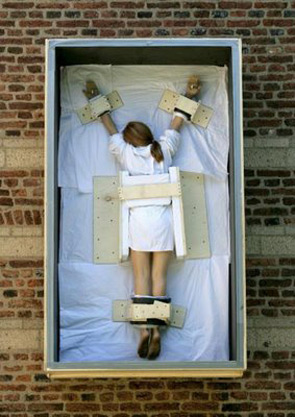
Anyway, my surprise didn't end here. I entered and I've seen a piece by Maurizio Cattelan hanging down in the altar. Cattelan is well known for being a provocateur, but he always does it in a smart and unexpected way.
Well, to see this artwork inside a church in Naples was a strong experience for me. I sudden thought: this must have created loads of polemics. When I came back in my hotel, I checked in the Internet and actually what I thought was true. Cattelan's piece didn't get a lot of support from Naples.


I discovered that Cattelan took the image from a picture of the artist Francesca Woodman, famous for her black and white photographs featuring herself, who died in 1981 for suicide.


In the first exhibition, the artwork didn't have the box all around. But then Cattelan saw it packaged, and he understood this was the finished work.

In Italy sometimes things are really predictable. I knew this artwork was criticized, even if I still don't understand why. I know it is a strong image, but not stronger than some olden painting with martyrs rapresented.
But for a contemporary critique artwork, doubt and disdain are automatic as a matter of course.

Food for Thought

The Museum of Everything

To start with, I have to say I consider the title of this exhibition as really inappropriate. It should be something like ‘Inside Outsider art’ or ‘Museum of the Outcasts’, well, something more challenging at least! But anyway...

The Museum of Everything was a temporary museum located in Chalk Farm where all the artwork displayed were made by artists often not recognized as such. Essentially, all artworks were made by, let’s say, ‘normal people’ and not worldly notorious artists. Therefore, their works are way more personal and intimate of the ones that we can contemplate in a normal museum. Jean Dubuffet was the discoverer and the main fan of the art described as art brut, a term coined by Dubuffet himself. The French artist wrote about Outsider art:
"Those works created from solitude and from pure and authentic creative impulses – where the worries of competition, acclaim and social promotion do not interfere – are, because of these very facts, more precious than the productions of professionals. After a certain familiarity with these flourishings of an exalted feverishness, lived so fully and so intensely by their authors, we cannot avoid the feeling that in relation to these works, cultural art in its entirety appears to be the game of a futile society, a fallacious parade."


I think I am really near to his position, above all nowadays, when the mainstream art market is so wide that every artist, as soon as he is recognized, becomes a sort of celebrity. Taking the example of Damien Hirst. He is maybe very talented, but in my opinion the sudden success made him lose the honesty. I think his works are spoiled by a system that asks him for this. He should use his talent to actually communicate something to the viewer, but I don’t see any message in his works, just ostentation and superficiality.

Well, in the Museum of Everythink you definitely cannot find this. All artworks were created from a genuine impulse, a real need to express what’s inside, in the unconsciousness. All artists are persons that never met success thanks to their works; they simply had the unavoidable necessity to create. Most of them are complicated and troubled minds, such as the first that was considered as an outsider artist, that was Adolf Wölfli, a psychotic mental patient that in the 1920s created an immense quantity of outstanding drawings. This is one of them:


In the Museum there were few works made by an artist that I love. She’s Judith Scott, a woman that was born deaf and with Down Syndrome. At the age of 44, she started making those incredible sculptures just taking an object and wrapping it in many layers of coloured yarns. The results are something beautiful and creepy at the same time.

Judith Scott, Untitled (JS-9), 2005, fibre and found objects

Another impressive example of outsider art is Nek Chand’s work. He created a monumental rock garden in the remote city of Chandigarh north of Delhi, India. Collecting broken plates, bowls, bottle tops from the railway tracks, he built day after day sculptures of different figures. When the municipality first discovered his illegal work, they wanted to destroy it. But then they recognized the beauty and importance of this creation and supported him with assistants and a stipend. Now the place in India is very famous and highly visited by art-lover tourists from all over the world.


When I was living in Madrid, I attended a course about Outsider Art. From that point I started being very interested about the issue. And I discovered a different perspective to look at art. Moreover, it actually changed my conception of art. Now I concieve art as something that a person can have or not. Is something like a divine gift. And some people can have it, but waste it because they don't know how to listen to the divine they have in themselves.
Artists in the Museum of Everything knew how to listen.
They knew the silence of the solitude.

Yves Klein – Blue is the color of our soul.


One day I found an ad on Artsjob.com. It said: we’re looking for cellists, no professional required; you just have to be able to play a D note. It’s for a performance made by Yves Klein in 1960 that we want to present again.


I thought it was a divine sign. I have the cello here in London and I use it very seldom. And also, I always loved Yves Klein and his blue. I didn’t know about the performance. Basically, it was a forty-minutes long show, with an orchestra playing the Monothone Symphonie (just an extended D note) and in the middle a pause of twenty minutes of complete silence, where the audience should contemplate the shapes left by the body of naked models painted with blue paint.


Being part of this was magical. I felt like the note and the color were all in one, on the same shade, the same tonality. I felt music was coming out from my body, from all bodies of musicians, and from our body it was going to the naked models’ bodies, to cover them with its blue vibration. Then silence. At the beginning it was embarrassing. But then I concentrated on the canvas on the stage, with shapes of blue body on them.

At one point I was so focused that I didn’t even notice that, in the silence, I started hearing the note D.

Mincemeat.

Mincemeat is a site-specific promenade performance created by Cardboard Citizens, a theatre company working with homeless people.

Mincemeat is a show that takes the audience throughout a huge warehouse in the middle of Shoreditch, a narrative that deal with questions of identity and matters of life and death, unraveling the mysteries surrounding a World War Two intelligence operation. The story is based on a real fact: in 1943, the body of a military man has been founded dead on a Spanish beach. Was his death necessary to prevent the death of thousand? Or was he just a guinea pig?

In 1943 the Allied powers planned to make landfall in Europe via Sicily. In order to convince the Germans that the invasion would come through Sardinia instead of Sicily, they devised a plan called Operation Mincemeat, that consisted in dropping a poor soldier’s body off the coast of Spain.


Mincemeat is a psychological drama, extremely strong and passionate, it makes you angry and makes you cry, and the location is something incredible, a huge warehouse with several rooms putted to use as interiors of a re-imagined wartime Londoner building. Actors are excellent, and all of them were homeless people. The show ended with the last cues of The Great Dictator by Chaplin, a message of hope and joy:

We are coming out of the darkness into the light! We are coming into a new world; a kind new world, where men will rise above their hate, their greed, and brutality. Look up, Hanna! The soul of man has been given wings and at last he is beginning to fly. He is flying inti the rainbow. Into the light of hope! Into the future! The glorious future! That belongs to you, to me, and to all of us. Look up, Hanna! Look up!


Just out of curiosity: while I was attending the show, I turned my gaze around and I discovered that behind me there was the actress Kate Winslet. Beautiful. I loved her in the movie Eternal Sunshine of the Spotless Mind by Michel Gondry. Truly beautiful.

The Shunt. My experience, behind the scenes.


Video


I’ve been to Shunt in October for the first time. You enter through this tiny door, inside London Bridge Station. They ask for your ID. Security reason, they say. Then suddenly and unexpectedly you’re inside this cavernous space. Humidity and smell of cellar, walls made of bricks and darkness, but slowly your eyes start to see a lot of candles all around. At first, you feel lost, and also a little scared. You don’t know where to go and why. But then you realize there are paintings on your right side, and on the left a small room with live music. And you feel like you’re wandering in a place where there’s no time and no rules. We’re in the underground. Everything is possible in the underground. As in the movie by Emir Kusturica. The place is huge; performances are going on in the course of all the night. Musicians, workshop, and installation: all around you. It’s a truly strong experience. The night then finished with a DJ, dancing until someone fights you off.


This is Shunt. Which better place to spend your Friday and Saturday evenings? I felt in love with the idea of a multi-artistic venue, in a location so beautiful and big. The day after, I looked for more information on the web, and I discovered that an experimental theatre group composed by ten actors is running the place. They moved to the ‘vault’ in 2004, and before this, they were located in a small railway arch in Bethnal Green.
When I noticed on their website that they were looking for volunteers, I didn’t wait a minute. I send them my CV and the week after I was there, the light of the day outside, and inside: no time, no hours… only that magical atmosphere which struck me from the first time. Cleaning chairs, painting walls, preparing set design for the performances: these were (and still are) my tasks during the day. In the night I’m the usherette, giving information to lost people, as I was.

I also worked as an usherette (dressed as a policemen) in the theatre production that is running from October called Money. It’s an experimental piece of theatre: this means there is not a clear narrative structure as in traditional theatre and also they want to make the viewer feel involved in the act. The entire act is located in a warehouse with a huge machine inside that was constructed exclusively for the show. It’s really an impressive construction, with four floors all of them with glass, and the show takes place inside different rooms on different floors, so that the audience has to move around it, never knowing what is going to happen next.


I’m really happy about the opportunity Shunt gives to every kind of person that wants to get involved in something creative and satisfactory. Surely it’s a big help for them to have such a lot of people working for free, but on the other hand they’re always really concerned about the wellbeing of all volunteers, they always smile and thank everybody and they have a lot of rewards such as free guest list for friends of volunteers, free drinks and also the possibility to propose artistic projects for the nights.

Maybe one day I’ll be on the scene. But for now, I’m happy to be behind them. The shows are definitely more exiting from this point of view.

Art Bin- The Art of Destruction.


Is destruction necessary?

Destruction in art is an oxymoron, since art is creation. But is exactly the complex cohabitation of these two concepts that create an extreme act that stuns, upsets, provoking a reaction.

'The need to destroy is also an artistic need' declared Picasso.
Also Nietzsche argued that destruction is necessary to creativity:
'The man who breaks… tables of values, the breaker, the lawbreaker; …he is the creator'

(Nietzsche, Also Spracht Zarathustra, p.23).

Dadaism has already dealt with this issue: according to the movement, everything had to be overkill in order to create something new. In the case of Dadaism, it was a figurative and conceptual argument, that shoots for create a renewed conception of art that is not only a bourgeois whim.

In other cases, destruction has not just a figurative sense.

As we already saw with Baldessari, there are some artists that deliberately decided to destroy their works. Not only, there are artists that make destruction their own form of doing art. It’s a fact that really interests me a lot. In fact, in our society, the consumer society, destruction has only a negative value, whereas production and accumulation (capital accumulation) are the successful mechanisms.

I’ve seen Gustav Metzgers personal exhibition at Serpentine Gallery in November. He is an artist and political activist and he developed the concept of Auto-Destructive Art. From the manifesto: “Auto-Destructive Art wants to recreate the obsession for destruction (…), it demonstrates the man’s power in accelerate the disintegration of natural processes” From 1959, he started making works by spraying acid on canvas as a protest against nuclear weapons. The results were changing really fast, until the canvas was all consumed. In 1960 he organized a public demonstration of Auto-Destructive Art that was one of the first happening in the art scene.


Also Jean Tinguely, the Swiss artist known for his sculptural machines, created in the same years (1960) a machine called Homage to New York, which was constructed to be self-destroyed. It was a 27 minutes long performance, and at the end of it, the public was allowed to take the remnants of the machine for souvenirs.


The English artist Michael Landy realized an installation that is a direct consequence of the previous listed artistic acts. In 2001, he destroyed all his possessions (all of them!!!) in the installation with the title Break Down. This year he decided to hurl from a staircase all the paintings collected in his life, and some of them are by notorious artists such as Damien Hirst or Tracy Amin. He also open the installation to everybody wanted to bring his artwork and throw it from the staircase on the ground with all the else artworks lied. The exhibition called Art Bin was in South London Gallery until the 14th of March, there were displayed all photographs and video of the performance and also the big glass bin with lifeless artwork comprehended.


I read in an article on the web that Kane Cunningham, a painter from Yorkshire, bought a house in Knipe Point, near to Scarborough. This house is located near to a precipice and it is highly possible that it will slide down. The artist decided to document the fall of the estate and transform it in a big artistic project. He wants to create a symbol for lost dreams and financial disasters, inviting also poets and musician and also visitors to leave their messages or artworks, in order to transform this precarious building in something creative and positive.

So, it is destruction necessary?

I think it is. Destruction is like death, people have to face with it, and start to see the good in it. Everybody should be ready to destroy a part of his property, as Michael Landy did. Things are not important to determine who we are, and artworks neither. What we do is basic, not what we own.. And destroying, we are the creator of a brave and proud act of rebellion.


Pete Townshend of The Who.

John Baldessari

In October I've been to John Baldessari's exhibition called Pure Beauty at the Tate Modern.
I enjoyed being there, the exhibition area was clevery arranged in a way that the viewer had the impression to walk through the artist's past, following a route that tells a story, with a sort of implicit logic and narrative structure.
I really felt like I was being conducted in Baldessari's mind, and this was a good sensation.


Baldessari's artistic investigation is addressed towards the language, and from the beginning of his work it is possible to notice it. He's also very interdisciplinar: he mixs painting, photography, performance and video, questioning the role of art in the society.
He questioned not only the role of art, but also the role of the artist: in the series called Commissioned Paintings he asked to some beginner painters to reproduce a photography of a hand pointing at some objects, and at the end of their works he signed the canvas writing "a painting by" and the painter name.


John Baldessari, Commissioned Painting: A Painting by Patrick X. Nidorf O.S.A, 1969.

It seems really interesting to me, above all after having studied all the theory related with the debatable theme of authorship, a central point in postmodern literature, where Roland Barthes and Michel Foucault's essays are the core of the argument.

From the 70s, after the Cremation Project, where he burned all his artworks made between 1953 and 1966, his art become more focused on photography, incorporating in his works waste materials and freeze frame from cinematographic film.

Putting together daily or senseless images, the artist is able to build a particular narrative, and suggest different ways to look at the reality. Baldessari uses unusual elements and inadeguate combination to create a state of tension. It can be a kiss in a mass of guns, a small stream of blood on the face of an actress with a pelicans' flock behind, impossible dialogues between a couple; he asks to the viewer to redefine the relations and the reactions of a two-dimensional stravagant world.

From the 80s he starts to use white and black photographies, obliterating the faces with coloured discs, and putting together different images, creating balance and connection where there was any.


John Baldessari, Heel, 1986.

From the 90s there is a return to the association of texts and images. The artist compounds words taken from Francisco Goya's paintings with pictures of banal objects.

I really liked the latest work by Baldessari: Brain/Cloud (Two Views): with Palm Tree and Seascapes (2009).
There was a camera that was projecting the image of you on the wall in front of you, making you feel actually a part of the installation. And part of the huge brain/cloud that was hanging on the wall/sky. Basically, part of Baldessari's brain.

Israel - Is real? >>Second part. The space outside the Institution.


While in Tel Aviv the Biennal attracts tourists and rich collectors, showing outsider art in little rooms and selling Bansky's prints for a lot of money, the city, silently and for free, shows how rich and wide is the street art panorama.
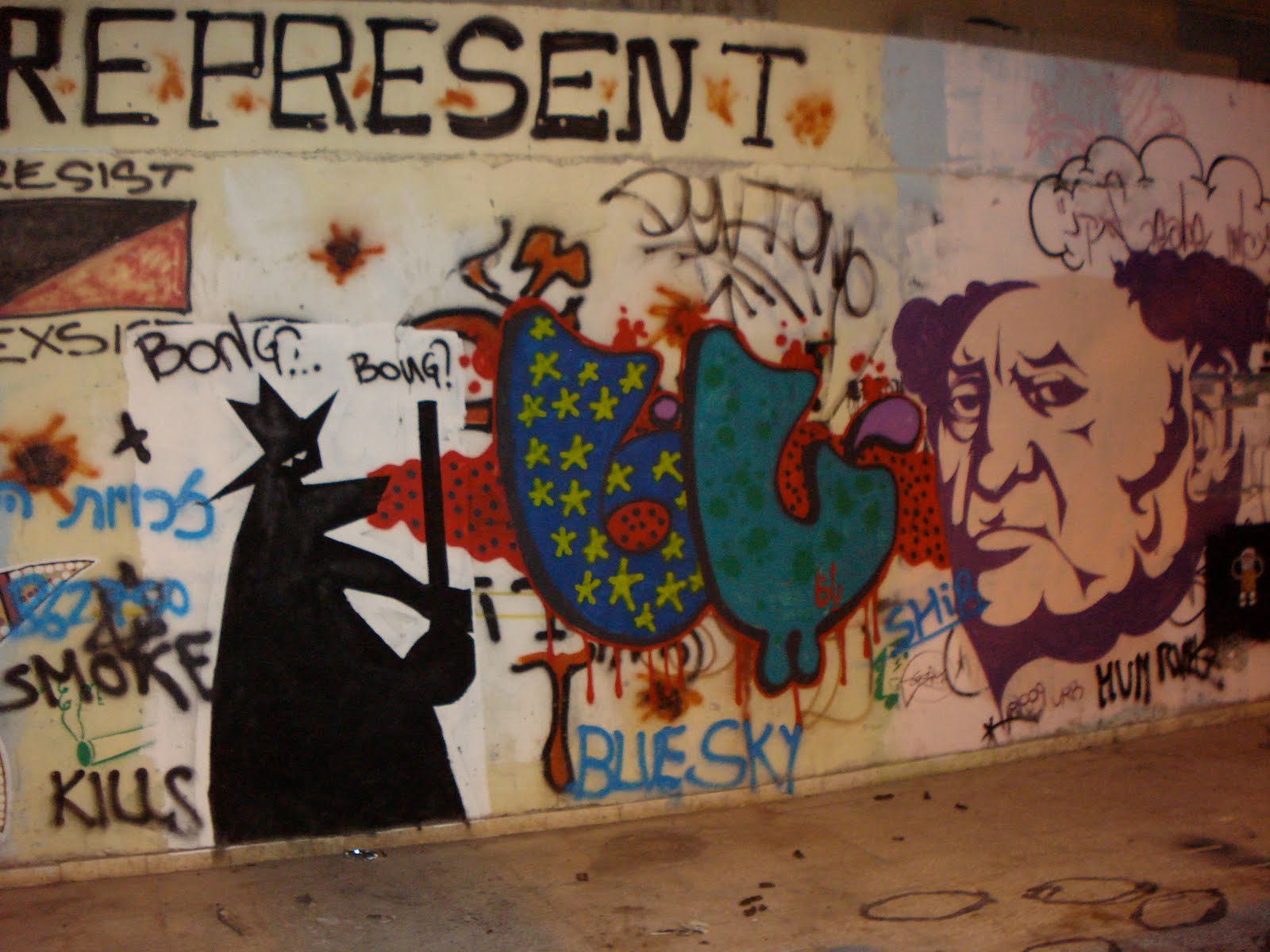
Every corner has a stencil or a stunning graffiti.


Wandering in the streets one sees the surprising cohabitation of a harsh past with marks of air raids on the buildings, and a new and hopeful present represented by young creative artists that leave their messages on the walls.


I was positively stunned by this high activity of street art, because it made me understand that there is a new generation in Tel Aviv that wants things to change, that believes in artistic power to sensibilize people and criticize the actual government, that wants to speak to everybody through their signs on the walls.

To see more: Israeli Street Art on Flickr

Thanks to my friends, I knew there was an opening of a sort of exhibition in a squat.
It was hard to find, but finally we managed to get there, asking direction to everybody alive I was meeting on my way.

The daily light was about to disappear, leaving slowly the sky to the darkness.
It was one of the typical Israeli evening, incredible sunset and a dreamy atmosphere, with dust in the air and a vibrating sense of excitement.
The builing we were looking for so long was in front of us: it was an abandoned 19th Century ruin in the South of the city, once considered the poor end, and now known as the alternative and arty part.
We saw people sneaking in through a hole in the wall. We followed them.

KINDRED TIMES AND FUTURE GOODBYES


I personally took this pic above. The building was open in the ceiling, and from the inside it was painted all around. There was a true vernissage, with free drinks and something to eat. All free. People were estrange, looking up and around fascinated.


There was a journalist, Leah Borromeo, located in London. (all other pictures are her)
She was interviewing the artists and then she asked me some comments about the event compared with the Biennal.


I was happy to tell her my opinion.
Art for me is not art if it's not dangerous.
In other words, real art should hit the nail on the head, should create a space of crisis, should destroy or at least question something.
If it's not doing it, it represents just a nice idea, another nice and harmless idea that will bring no consequence. The world is full of nice ideas. They are all there, with a price on them, waiting to be bought.
The Biennal was a storage of nice ideas as well.
Nothing really striked me, but maybe they even did not want to strike people.
They just wanted to entertain the viewers. Yes, I know, art is often this.
But art as entertainment is not my art.

Leah smiled, she looked satisfied. I've never thought I would have met her again, here in London. But sometimes the world is a hole.

Here you can read her article.


"In a world tripping on its own undone shoelaces. (We are our surroundings.)"
(from a writing on a wall.)

Israel - Is real?


On September 2009 I've been travelling around Israel.
My Israeli friends, who I used to live in London with, gave me hospitality in Tel Aviv.
In that period, the Biennal of Art called ArtTLV 09 was running in various places all around the city.
It is interesting to know that the organization for the event started in 2008, and at first the curators were the well-know Zdenka Badovinac and Viktor Misiano. Then, in December, Israel attacked the Gaza Strip. The two curators decided to keep their jobs only if the Israeli government would not be the sponsor of the Biennal. Unfortunately, there was not enough time to find private sponsors, so they gave up, leaving the task to a local curatorial team, that makes the event something less international.

I've seen quite a lot of interesting and challenging artworks there, but not so controversial and politically engaged as I expected.


The work by Shelly Federman was a big surprise. The 34-years-old artist from Israel made an installation on the beach of Tel Aviv (see above) that wanted to recreate the West Bank barrier in a public place dedicated to amusement and relaxation as a beach.
She says "I wanted to make the wall visible, and in doing so make people feel uncomfortable." The installation was filmed and the result is a short video in which turists used the sponge wedges as surfboards and lounge chairs (maybe the best thing to do with the real wall as well?).


Part of Shelly Federman's separation wall artwork at the Tel Aviv Art Biennial

Another work that I enjoyed was an installation by the Moroccan artist called Mounir Fatmi (nice website!) that I already knew from an artwork he presented to the 2007 Venice Biennale.

In the installation I saw in Tel Aviv, he used 1.500 VHS glued to the wall in order to represent the shape of a skyscraper skyline.
The work gives me a sense of drama and darkness, mixed with a bit of irony.

Mounir Fatmi, Skyline, 2007.

After Architecture_moumir fatmi_web


Looking for Beauty in a Ogres' World

Hi there, silent and unknown users of this space of dispersion called Internet.
Today I'm starting typing my adventures in the world of contemporary art.
Sometimes it will be intimate, some others more theoretical, but I will try to make it as unexpected as possible.
Maybe inarticulate sometimes.
But always committed.
At least I'll try.
Enjoy the reading.
Image: Francesco Clemente, Abbraccio (Hug), 1983.